ChromiumTap — Single-binary Zero-CRT C++23 browser credential, cookie, and payment card recovery tool: 296,448-byte standalone Windows x64 executable combining Direct2D/Mica GUI and CLI, LZX Cabinet payload masked inside wallpaper.bmp with IMPL0003 container and ks.sys DOS header reconstruction, direct x64 syscalls via MASM trampoline, browser COM elevation and AES-256-GCM decryption, overlapped named-pipe IPC with structured DiagnosticEvent localization, and Per-Monitor V2 DPI scaling.
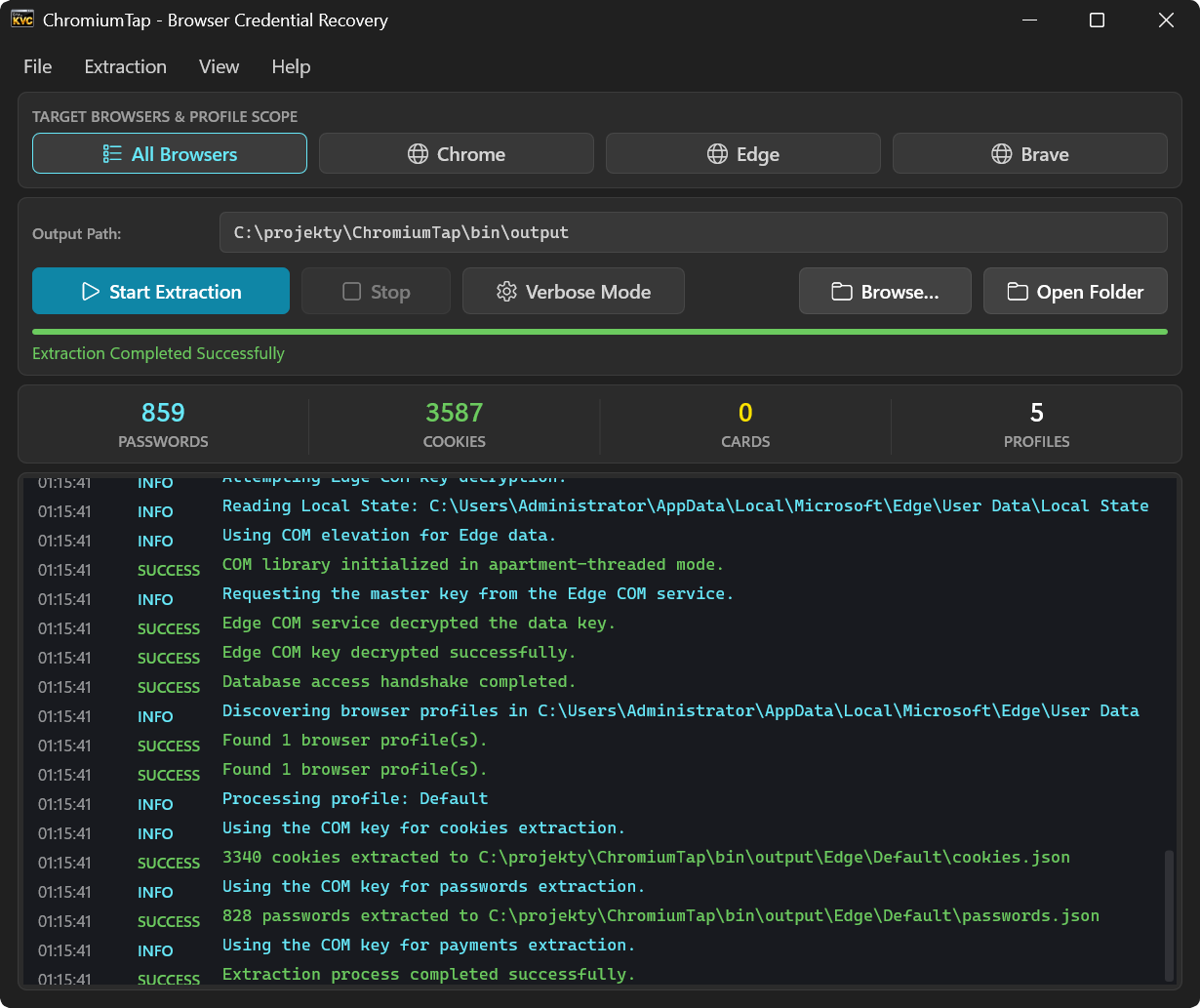
ChromiumTap on Windows 11 at 125% Per-Monitor V2 DPI: Direct2D Mica surface, browser target selector, live KPI counters, and localized diagnostic log.







Engineering Status
ChromiumTap.exeis a single standalone Windows x64 executable measuring296,448bytes. Both the orchestrator and theChromiumTap.dllextraction module are compiled with MSVC C++23 and MASM x64 under/W4 /WX,/NODEFAULTLIB,/GS-,/EHa-, and/GR-with zero CRT imports and zero CRT symbols. The DLL payload is stripped of its0x80-byte DOS header, packed into anIMPL0003v3 container, compressed via LZX Cabinet, masked at theMSCFsignature, and stored inIDR_WALLPAPER_BMPas a nativeRT_BITMAPresource. The resource compiler reduces the 31,254-byte bitmap file to a 31,240-byte DIB; the CAB length is preserved inbiClrImportant, and the runtime reconstructs the missing file-header context in memory. At runtime,EmbeddedModuleunpacks the stream in memory viacabinet.dllFDI, reads the first0x80bytes of the localks.sysDOS stub, verifies that template againsttemplateSha256, applies the recordede_lfanew, verifies the complete reconstructed DLL, and stages the image to aFILE_FLAG_DELETE_ON_CLOSEtemporary file. Launched without arguments,ChromiumTap.exeopens a Per-Monitor V2 Direct2D/DirectWrite Mica window; invoked with flags, it attaches a console and drives the samecore/engine.💡 Zero-UAC Execution — Why Standard User Privileges Suffice
ChromiumTap.exeruns from a standard, non-elevated user account with no UAC prompt, no Administrator membership, and noSeDebugPrivilege:
- Same-SID Process Ownership: Target browser processes —
chrome.exe,msedge.exe,brave.exe— run at Medium Integrity Level under the logged-on user SID, keeping all process operations inside the caller's security boundary.- Profile and DPAPI Locality: Vault files —
Local State,Login Data,Network\Cookies,Web Data— reside in the current user's local application data profile, andCryptUnprotectDatadecrypts against the current user's DPAPI master key. Elevating toAdministratororSYSTEMwould break user-scoped DPAPI context without token impersonation.- COM Elevation Validation: Browser elevation services —
GoogleChromeElevationService,MicrosoftEdgeElevationService,BraveElevationService— validate the calling browser binary's path and signature from within the browser process rather than requiring an elevated orchestrator token.
False Positives, AV/EDR Reality, and Author's Stance
ChromiumTap.exe does exactly what its source code documents: it extracts an IMPL0003 payload from an LZX Cabinet inside RT_BITMAP, reconstructs its DOS header from ks.sys, stages an unsigned PE via FILE_FLAG_DELETE_ON_CLOSE, executes direct x64 syscalls through a MASM trampoline, terminates browser helper processes holding SQLite locks, and queries browser COM elevation alongside user-scoped DPAPI and AES-256-GCM. Security products routinely flag that sequence as HackTool, PUA, or machine-learning Trojan:Win32/Wacatac.B!ml.
If you run the official build, verify its SHA-256 or compile it yourself from the published MSVC C++23 and MASM source tree. The same behavioral overlap has affected classic single-binary Win32 utilities like NirSoft's WebBrowserPassView for two decades: False Virus/Trojan Warning.
Why This Blog Does Not Worship AV/EDR
Coming from the Iczelion and SoftICE era, my workflow is built on understanding the operating system rather than delegating judgment to a heuristic black box:
- Full local control over hand-holding: I do not wrap every step in
sudo-style prompts and I do not keep an always-on AV engine throttling I/O and process creation. When performance or deterministic behavior matters, I disable Windows Defender on demand or kill it outright. - No need to vandalize the OS: I do not recommend destructive third-party gutting tools such as
defender-removeror similar scripts that rip out system components and break servicing. Knowing how services, minifilters, andg_CiOptions/PS_PROTECTIONwork gives you clean, reversible control without trashing Windows. - AV/EDR is an attack surface, not a silver bullet: Every resident security agent installs complex kernel drivers, minifilters, and privileged remediation parsers that expand the Ring-0 and
SYSTEMattack surface. The track record speaks for itself: Microsoft Defender TOCTOU and link-resolution LPEs inmpengine.dlland the platform (CVE-2026-33825BlueHammer,CVE-2026-50656RoguePlanet,CVE-2026-69414ShieldBreak), CrowdStrike Falcon's remediation TOCTOU LPE (CVE-2026-40058FalconFlank) alongside theCSAgent.sysRing-0 out-of-bounds read (C-00000291*.sys), Kaspersky kernel IOCTL/pool bugs (klif.sys,kldisk.sys), and K7 driver/named-pipe LPEs (K7RKScan.sysCVE-2025-1055/CVE-2025-52915,CVE-2025-67826) all turned "protection" software into direct paths to BSOD orNT AUTHORITY\SYSTEM. - Undisclosed driver research: Seven out of the 37 vulnerable drivers identified in my own research—kept undisclosed—contain bugs completely missed by AV and EDR engines. Several of them allow direct escalation from a standard user token to
NT AUTHORITY\SYSTEM, including inside supposedly hardened, "bulletproof" drivers that vendors ship to protect the host. There is a practical reason I do not publish every finding: after my June 2026 ForceIO write-up onIObitUnlocker.sys(IOCTL 0x222124, WHCP-signed and absent from Microsoft's blocklist at the time), public CVE and blocklist entries such asCVE-2026-82671followed roughly two months later covering the same surface. Publishing everything only feeds derivative advisories; keeping the sharpest primitives private is deliberate. An ML label like!mlsays far more about a product's pattern matcher than about the actual security posture of the machine.
Technical Detection Mechanics
For engineers testing ChromiumTap.exe on locked-down hosts or corporate EDR labs, these are the concrete events that trigger classification:
- User-context execution: Normal extraction runs under the logged-in user SID with no Administrator token, no UAC prompt, and no
SeDebugPrivilege. - Behavioral sequence over filenames: Staging
wallpaper.bmpas an ephemeral file withFILE_FLAG_DELETE_ON_CLOSE, mapping an unsigned PE reconstructed fromks.sys, and terminating browser network-service child processes form an observable chain. Renaming.dllto.bmpis an implementation detail of the container, not a security boundary against behavioral hooks. - Environment variance: Verdict and label depend on the exact Windows build, Defender platform and signature revision, ASR rules, SmartScreen state, and publisher certificate trust. A locally trusted code-signing certificate changes publisher reputation, not behavioral telemetry.
- Reproducible diagnostics: If you log or compare detections across builds, record the exact Defender/EDR engine and signature version, Windows build, ASR state, and whether the trigger was static file reputation or runtime process/file sequence.
Table of Contents
- Quick Start
- False Positives, AV/EDR Reality, and Author's Stance
- Technical Overview
- System Architecture
- Steganographic Bitmap Carrier and
IMPL0003Container - Zero-CRT Runtime and Direct Syscall Layer
- Cryptographic Key Hierarchy and Storage Decryption
- Security Considerations: The Elevation-Service Boundary
- Inter-Process Named-Pipe Protocol and Cancellation
- Direct2D, DirectWrite, and Per-Monitor V2 Mica Interface
- Localization and Build-Time Catalog Verification
- Command-Line Reference
- Source Layout
- Building from Source
- License
Quick Start
ChromiumTap.exe runs as a Direct2D desktop window when invoked without arguments and as a console orchestrator when passed command-line flags. Both paths share core/ and unpack the embedded extraction module on demand.
1. Graphical Interface
- Copy
ChromiumTap.exeto any directory — no accompanying DLL or language files are required. - Launch
ChromiumTap.exedirectly from a standard user account. - Select the scope under Target Browsers & Profile Scope:
All Browsers,Chrome,Edge, orBrave. - Set Output Path via Browse… (
Ctrl+O), toggle Verbose Mode if required, and click Start Extraction (Ctrl+E). - Monitor live Passwords, Cookies, Cards, and Profiles KPI counters and the diagnostic log; click Stop or press
Escto cancel viaCancelIoEx.
2. Command Line
:: Extract credentials, cookies, and payment cards from all detected browsers with verbose diagnostics
ChromiumTap.exe all -v

:: Target Google Chrome only and write JSON/CSV reports to a custom audit directory
ChromiumTap.exe chrome -o <output-directory>

:: Target Microsoft Edge with diagnostic telemetry
ChromiumTap.exe edge --verbose

:: Display command-line usage
ChromiumTap.exe --help
3. Typical Workflows
- Multi-profile audit: run
ChromiumTap.exe all -v -o <case-directory>to enumerate every profile underUser Data—Default,Profile 1,Profile 2— and export decrypted records in one pass. - Locked databases or stale TypeLib entries: open Extraction in the GUI menu bar and invoke Terminate Locking Browser Processes or Fix Chrome TypeLib Registry Paths before extraction.
- Runtime language switching: toggle between English and Polish under View → Language without restart; the window re-measures layout geometry, updates the caption, and redraws from embedded
STRINGTABLEresources.
Technical Overview
| Subsystem | Implementation |
|---|---|
| Single-binary carrier | ChromiumTap.exe embeds ChromiumTap.dll inside the IDR_WALLPAPER_BMP RT_BITMAP resource DIB (31,240 B) as an LZX-compressed IMPL0003 container. The stripped 0x80-byte DOS stub is reconstructed from the current system's ks.sys; the container stores and verifies its SHA-256 and the original e_lfanew. Total executable size: 296,448 bytes. |
| Zero-CRT runtime | Links with /NODEFAULTLIB, /GS-, /EHa-, and /GR-. Heap allocations route through GetProcessHeap() in support/RuntimeSupport.cpp. Zero CRT imports and zero CRT symbols. |
| Direct x64 syscalls | support/syscalls.cpp extracts SSNs and syscall; ret gadgets from ntdll.dll exports at runtime; support/AbiTramp.asm performs register marshaling in MASM x64. |
| Cryptographic extraction | Handles App-Bound Encryption v20 via browser IElevator COM interfaces, Edge split-key DPAPI fallback in core/EdgeDPAPI.cpp, and AES-256-GCM via bcrypt.lib. |
| Overlapped IPC & cancellation | core/CommunicationLayer.cpp pairs OVERLAPPED named-pipe reads with WaitForMultipleObjects on {m_ioEvent, m_cancelEvent} and CancelIoEx. |
| Structured event framing | Engine telemetry crosses the pipe as \x1e<level><event_id>\x1f<args...> frames (15000+), decoded uniformly by GUI and CLI without logging raw key material. |
| Direct2D & Mica UI | Pure Win32, Direct2D, and DirectWrite with DWMSBT_MAINWINDOW Mica backdrop, SPI_GETHIGHCONTRAST fallback, Per-Monitor V2 DPI scaling, and RAII guards in gui/Handle.h. |
| Build-time l10n check | build.ps1 verifies key parity and {} placeholder arity across en.rc and pl.rc (125 keys) prior to compilation under /W4 /WX. |
System Architecture
browser selector · KPI strip · log"]) CLI(["CLI / console
same engine · scriptable output"]) CORE["Core orchestration
browser discovery · PID resolution · policy"] PIPE["Named-pipe server
OVERLAPPED I/O · cancellation"] EMB["EmbeddedModule
BMP → FDI → IMPL0003 → PE"] end subgraph BROWSER["Browser process — caller's user SID"] DLL["ChromiumTap.dll
mapped extraction engine"] COM["IElevator / IElevator2 / IElevator3
app-bound master-key unwrap"] DPAPI["Edge split-key DPAPI
orchestrator-side fallback"] SQL["winsqlite3.dll
Login Data · Cookies · Web Data"] GCM["CNG AES-256-GCM
v10 / v20 records"] end subgraph OS["Windows services and interfaces"] CAB["cabinet.dll
FDICreate · FDICopy"] CNG["bcrypt / CNG
SHA-256 · AES-GCM"] SCM["Browser helper services
network · storage · elevation"] end GUI --> CORE CLI --> CORE CORE --> EMB EMB --> CAB EMB -->|verified PE image| DLL CORE -->|diagnostic requests| PIPE PIPE -->|localized events| CORE PIPE -->|pipe messages| DLL DLL -->|status responses| PIPE CORE -->|suspend / resume / cleanup| SCM DLL --> COM DLL --> SQL DLL --> GCM CORE --> DPAPI DPAPI -->|key material| PIPE COM --> CNG SQL --> GCM classDef ui fill:#ecfeff,stroke:#0891b2,color:#083344,stroke-width:1.6px; classDef core fill:#e0f2fe,stroke:#0284c7,color:#0c4a6e,stroke-width:2px; classDef engine fill:#ecfdf5,stroke:#059669,color:#064e3b,stroke-width:1.8px; classDef crypto fill:#fff7ed,stroke:#ea580c,color:#431407,stroke-width:1.6px; classDef system fill:#f8fafc,stroke:#64748b,color:#0f172a,stroke-width:1.4px; class GUI,CLI ui; class CORE,PIPE,EMB core; class DLL,COM,DPAPI,SQL engine; class GCM crypto; class CAB,CNG,SCM system; linkStyle default stroke:#0891b2,stroke-width:1.5px;
The GUI thread maintains no cryptographic or injection state. MainWindow::WorkerThreadProc executes core/ on a dedicated worker thread, posts updates to the window procedure via PostMessageW, and synchronizes counters (m_statPasswords, m_statCookies, m_statCards, m_statProfiles) and control flags (m_isExtracting, m_cancelRequested) using std::atomic and manual-reset Win32 events.
Steganographic Bitmap Carrier and IMPL0003 Container
Carrier Layout in wallpaper.bmp
Rather than shipping ChromiumTap.dll alongside ChromiumTap.exe, the build pipeline embeds the extraction DLL inside resources/wallpaper.bmp (31,254 bytes) and links it as IDR_WALLPAPER_BMP (BITMAP). The source file is a complete 24-bit BMP beginning with 'B', 'M'; rc.exe recognizes it as an image and stores the 31,240-byte DIB form in the executable. The 14-byte BITMAPFILEHEADER is omitted from the resource, so EmbeddedModule::UnwrapBitmap accepts both the full-file BM form and the headerless DIB returned by FindResourceW(..., RT_BITMAP):
native x64 PE")] STRIP["Strip first 0x80 bytes
record e_lfanew"] CONTAINER["IMPL0003 v3
records · sizes · SHA-256"] CAB["LZX Cabinet
single compressed stream"] MASK["XOR first 4 bytes
MSCF → A5 5A F0 0F"] BMP[("wallpaper.bmp
31,254-byte RGB file
31,240-byte RT_BITMAP DIB")] KS["Local ks.sys image"] TPL[("Local ks.sys
first 0x80 bytes")] DLLIN --> STRIP --> CONTAINER --> CAB --> MASK --> BMP KS -->|read exactly 0x80| TPL TPL -->|SHA-256 of 0x80| CONTAINER end subgraph RUNTIME["Runtime extraction"] RES[("IDR_WALLPAPER_BMP
RT_BITMAP · raw DIB")] UNWRAP["Detect BM or DIB
read CAB size · restore MSCF"] FDI["cabinet.dll FDI
memory-only callbacks"] OPEN["Validate IMPL0003
offsets · sizes · flags"] STORED["Verify storedSha256
of PE body"] TRES[("Local ks.sys template")] THASH["Verify templateSha256
exactly 0x80 bytes"] REBUILD["Prepend 128-byte template
patch e_lfanew"] FINAL["Verify reconstructed SHA-256
and PE signature"] STAGE[("Temporary PE image
DELETE_ON_CLOSE")] RES --> UNWRAP --> FDI --> OPEN --> STORED --> REBUILD TRES --> THASH -->|template matches container| REBUILD STORED -->|body accepted| REBUILD REBUILD --> FINAL --> STAGE end BMP --> RES TPL --> TRES classDef artifact fill:#f1f5f9,stroke:#475569,color:#0f172a,stroke-width:1.5px; classDef transform fill:#e0f2fe,stroke:#0284c7,color:#0c4a6e,stroke-width:1.8px; classDef verify fill:#ecfdf5,stroke:#059669,color:#064e3b,stroke-width:1.8px; classDef template fill:#fff7ed,stroke:#ea580c,color:#431407,stroke-width:1.6px; class DLLIN,BMP,TPL,RES,TRES,STAGE artifact; class STRIP,CONTAINER,CAB,MASK,UNWRAP,FDI,OPEN,REBUILD transform; class STORED,THASH,FINAL verify; class KS template; linkStyle default stroke:#0891b2,stroke-width:1.5px;
 Raw 24-bit bitmap carrier (
wallpaper.bmp, 104 × 100 px)
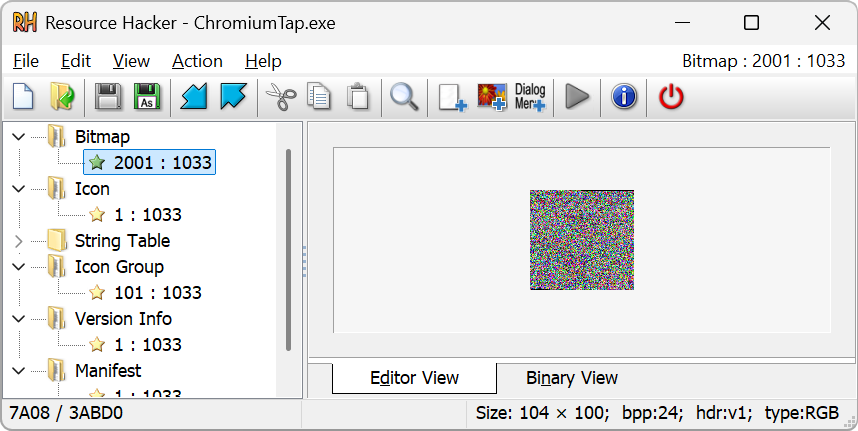 Embedded
BITMAP 2001 in ChromiumTap.exe (Resource Hacker)
RT_BITMAP DIB carrying the LZX-compressed, XOR-masked IMPL0003 extraction module| On-disk file offset | Field | Purpose |
|---|---|---|
+0x00 |
bfType |
Checked against 'B', 'M' |
+0x02 |
bfSize |
Validated against bitmapSize (declaredSize <= bitmapSize) |
+0x06 |
bfReserved1 / bfReserved2 |
Stores cabSize (ReadU32(bitmap + 6)) |
+0x0A |
bfOffBits |
Stores pixelOffset (>= 54, cabSize <= bitmapSize - pixelOffset) |
The embedded resource omits the file header above. Its DIB has a second CAB-length record intended for the resource path:
| DIB-relative offset | Field | Runtime use |
|---|---|---|
+0x00 |
biSize |
Must be at least 40 |
+0x0E |
biBitCount |
Must be 24 |
+0x10 |
biCompression |
Must be BI_RGB (0) |
+0x24 |
biClrImportant |
Stores cabSize; unused by uncompressed 24-bit RGB |
+0x28 |
Pixel data | First byte of the masked CAB |
Before embedding into the bitmap, Implementer XORs the MSCF signature with {0xE8, 0x09, 0xB3, 0x49}. The resulting first four bytes stored on disk are {0xA5, 0x5A, 0xF0, 0x0F}. UndoCabMask reapplies the same key in memory and verifies the reconstructed MSCF signature prior to decompression.
In-Memory FDI Decompression and IMPL0003 Verification
support/EmbeddedModule.cpp invokes Windows cabinet.dll (FDICreate, FDICopy, FDIDestroy) through custom memory callbacks (FdiAlloc, FdiFree, FdiOpen, FdiRead, FdiWrite, FdiSeek, FdiClose) backed by GetProcessHeap(). Decompression yields the IMPL0003 version 3 container in memory:
| Structure | Key Fields | Validation |
|---|---|---|
ContainerHeader |
magic[8] ("IMPL0003"), version (3), count, headerSize, dataOffset, dataSize, templateSha256[32], flags |
Bounds-checked against kMaxContainerBytes (64 MiB) and container buffer size; templateSha256 covers exactly the first 0x80 bytes of the local ks.sys template |
FileRecord |
name[128] ("ChromiumTap.dll"), offset, storedSize, originalSize, storedSha256[32], originalSha256[32], flags, eLfanew |
storedSha256 verified via CNG BCryptHashData before PE reconstruction |
ks.sys DOS Header Reconstruction and Ephemeral Staging
To eliminate static MZ headers inside the compressed container and reduce payload footprint, the build strips the leading 0x80 bytes of ChromiumTap.dll and sets kFileFlagDosHeaderStripped (0x00000001). At runtime, EmbeddedModule::Extract performs four sequential steps:
- Template verification: Opens the current system's
ks.sys, reads exactly its first0x80bytes, computes SHA-256, and compares the result withview.header->templateSha256. The rest ofks.sysis not part of the container contract. - PE reconstruction: Copies the local 128-byte DOS stub into the output buffer, writes
record.eLfanewat offset0x3C, and appendsstoredSizebytes of the PE body. - Post-reconstruction integrity check: Confirms the
PE\0\0signature atrecord.eLfanewand verifies the full reconstructed image againstrecord.originalSha256. - Ephemeral file backing: The current diagnostic build creates
wallpaper.bmpdirectly in the current user's temporary directory withCREATE_NEW | FILE_ATTRIBUTE_TEMPORARY | FILE_FLAG_DELETE_ON_CLOSEandFILE_SHARE_READ | FILE_SHARE_WRITE | FILE_SHARE_DELETE. The fixed name supports controlled detection experiments and permits only one active instance. WhenEmbeddedModule::~EmbeddedModule()closesm_fileafter injection completes, the OS deletes the file once the last handle closes.
For the current DLL, 126 of the first 128 bytes match the local ks.sys stub exactly. The only changed field is e_lfanew: 0xF8 in ks.sys and 0x100 in ChromiumTap.dll, stored by the container and written at 0x3C during reconstruction. The packer detects PE content from MZ and PE\0\0, not from a filename extension, so the same record structure applies to .exe, .sys, .dll, .cpl, .scr, and other PE images.
Zero-CRT Runtime and Direct Syscall Layer
Heap Backing, Intrinsics, and __chkstk
Compiling with /NODEFAULTLIB removes ucrt, vcruntime, and msvcprt. support/RuntimeSupport.cpp supplies the freestanding C++23 substrate:
- Heap allocation:
operator new,operator delete,malloc,realloc, andfreemap directly toHeapAlloc,HeapReAlloc, andHeapFreeonGetProcessHeap(). - Memory intrinsics:
#pragma function(memcpy, memset, memmove, memcmp)provides explicit implementations so/O2optimization does not generate self-recursive calls. - Stack probing (
__chkstk): Provides the guard-page probing routine required by MSVC x64 for frames exceeding 4 KB, while hot routines insideChromiumTap.dllkeep stack buffers atMAX_PATHrather than 32 KB arrays to minimize stack growth inside target browser threads. - ABI stubs: Supplies
_purecall, a no-opatexit, and/Zc:threadSafeInit-.
Dynamic SSN Resolution and MASM x64 Trampoline
support/syscalls.cpp walks the in-memory ntdll.dll export directory at startup to populate SYSCALL_STUBS with 16-bit System Service Numbers and clean syscall; ret gadget pointers:
| Stub | Purpose |
|---|---|
NtAllocateVirtualMemory |
Remote virtual memory allocation |
NtWriteVirtualMemory |
Writing parameters and module path into remote memory |
NtReadVirtualMemory |
Reading remote PEB and module structures |
NtProtectVirtualMemory |
Transitioning section page protections |
NtCreateThreadEx |
Creating the worker thread in the target browser process |
NtFreeVirtualMemory |
Releasing remote allocations |
support/AbiTramp.asm implements the ml64 x64 trampoline, moving rcx to r10, loading ssn into eax, preserving stack alignment for arguments 5+, and jumping to pSyscallGadget.
Cryptographic Key Hierarchy and Storage Decryption
App-Bound Encryption v20 and COM Elevation
Chromium browsers (Chrome 127+, Edge, Brave) encrypt os_crypt.app_bound_encrypted_key in Local State via their system-level Elevation Service (GoogleChromeElevationService, MicrosoftEdgeElevationService, BraveElevationService). The service binds key unwrapping to the calling browser executable's identity. Executing inside the target browser process, ChromiumTap.dll initializes apartment-threaded COM, configures proxy security where required, and calls IElevator::DecryptData to recover the 32-byte AES-256-GCM master key.
Edge Split-Key DPAPI Fallback and AES-256-GCM
When Edge COM elevation is unavailable, core/EdgeDPAPI.cpp decrypts the DPAPI layer in the orchestrator process and transmits the key material across the named pipe (DPAPI_KEY:...). Encrypted v10 and v20 database records are decrypted in memory via Windows CNG bcrypt.lib (BCRYPT_AES_ALGORITHM in BCRYPT_CHAIN_MODE_GCM, 12-byte nonce, 16-byte authentication tag).
SQLite Access via winsqlite3.dll
Profile databases — Login Data, Network\Cookies, Web Data — are queried through Windows' built-in winsqlite3.dll via crypto/winsqlite3.lib, falling back to sqlite3.dll at runtime if winsqlite3.dll is absent.
os_crypt.app_bound_encrypted_key")] IE["Browser elevation service
IElevator · IElevator2 · IElevator3"] COMKEY["Decrypted 32-byte
AES-256 master key"] DPAPI["Edge split-key fallback
CryptUnprotectData"] DB[("SQLite rows
Login Data · Cookies · Web Data")] GCM["AES-256-GCM
v10 / v20 envelope"] OUT["Structured JSON / CSV
passwords · cookies · cards"] PIPE["Named pipe
localization events only"] LS -->|inside browser process| IE IE --> COMKEY DPAPI -->|orchestrator-side fallback| COMKEY COMKEY --> GCM DB --> GCM GCM --> OUT GCM -.->|status / counts / event IDs| PIPE classDef store fill:#f1f5f9,stroke:#475569,color:#0f172a,stroke-width:1.5px; classDef broker fill:#e0f2fe,stroke:#0284c7,color:#0c4a6e,stroke-width:1.9px; classDef secret fill:#fff7ed,stroke:#ea580c,color:#431407,stroke-width:1.8px; classDef output fill:#ecfdf5,stroke:#059669,color:#064e3b,stroke-width:1.8px; class LS,DB store; class IE,COMKEY,DPAPI,GCM broker; class OUT,PIPE output; linkStyle default stroke:#0891b2,stroke-width:1.5px;
Security Considerations: The Elevation-Service Boundary
Consequences and warnings. ChromiumTap never acquires a
SYSTEMtoken. The browser elevation service is a constrained decrypt oracle: it unwraps the 32-bytev20master key and returns plaintext into user space. The privilege stays inside the service. This section documents what the COM boundary grants, what it does not, and the residual attack surface it exposes — so the mechanism is not mistaken for a privilege-escalation primitive.
What the boundary grants — and what it does not
- Grants: unwrapping of
os_crypt.app_bound_encrypted_keyinto the 32-byte AES-256-GCM master key, in the caller's user context, with zero privilege growth. - Does not grant: a
SYSTEMtoken,SeDebugPrivilege, or arbitrarySYSTEMexecution. The service's token never leaves the service process. COM impersonation flows server→client — the service reduces itself to the caller for access checks — and never hands the caller the service's token.
The residual SYSTEM-side parser surface
The blob passed to IElevator::DecryptData is attacker-controlled data parsed in SYSTEM context:
- the RPC NDR unmarshaling layer, before the method body executes;
- the DPAPI and ASN.1 structures inside the blob, in the method body after
CoRevertToSelf.
A memory-safety defect in either — overflow, use-after-free, or length mishandling — executes as NT AUTHORITY\SYSTEM. This is a property of the browser's elevation service, not of ChromiumTap, but same-user injection into the medium-IL browser process is what makes that surface reachable. The identity gate authenticates the on-disk image path and Authenticode signature, not the provenance of in-memory code; injection satisfies that check by design. The gate raises the bar against direct-file-reading and cross-process stealers, but it is not a hard boundary against same-user injected code.
Real-world exposure
This surface is not hypothetical. The same COM elevation path is already abused in the wild for credential and cookie extraction — it is precisely the threat App-Bound Encryption was introduced to raise the bar against, and the reason injection-based techniques proliferated after Chrome 127. Browser updater and elevation services also carry a documented history of local privilege escalation classes — file-operation races, junction and symlink handling, and impersonation ordering. The DPAPI, ASN.1, and NDR parser paths are therefore a live, contested attack surface, not a theoretical one — which is why the analysis-versus-exploitation boundary and the vendor hardening above are operative guardrails, not an afterthought.
The impersonation window — direction matters
| Window | Effective token | Access checked against | Risk |
|---|---|---|---|
CoImpersonateClient active |
caller user | the user | Safe direction — junction or symlink redirection to protected resources is denied |
after CoRevertToSelf |
SYSTEM |
SYSTEM |
Validate-as-user followed by act-as-SYSTEM on a user-controlled path creates TOCTOU/LPE |
DecryptDatatakes the blob by value; it opens no caller-supplied path after revert, so the TOCTOU pattern applies to the service's file and installer methods rather than the decrypt oracle.- A handle opened under impersonation carries its granted access; reverting to
SYSTEMdoes not upgrade an existing handle.
Defensive implications
- Tool scope: ChromiumTap uses the designed decrypt oracle only and does not exploit the service. Analysis and exploitation remain separate.
- Detection: the observable chain — remote thread into the browser, COM call to the elevation service, and reads of
Login Data/Cookies/Web Data— is the primary signal, not the cryptography. - Vendor hardening: the service's DPAPI, ASN.1, and NDR parser paths are the high-value audit target; CFG, ACG, CET shadow stacks,
/GS, and fuzzed parsers raise the bar.
Inter-Process Named-Pipe Protocol and Cancellation
Overlapped I/O and Event-Driven Termination
core/CommunicationLayer.cpp (PipeCommunicator) and crypto/CommunicationModule.cpp (PipeLogger) communicate over a message-mode named pipe (PIPE_TYPE_MESSAGE | PIPE_READMODE_MESSAGE). Both server and client configure PIPE_READMODE_MESSAGE explicitly via SetNamedPipeHandleState so discrete protocol messages never coalesce on ReadFile.
Every connect and read operation binds an OVERLAPPED structure to a manual-reset m_ioEvent and waits with WaitForMultipleObjects on {m_ioEvent, m_cancelEvent}. When cancellation is requested via Stop, Esc, or window destruction (StopWorkerAndJoin()), the orchestrator signals m_cancelEvent, invokes CancelIoEx, and joins the worker thread with WaitForSingleObject(m_workerThread, INFINITE).
Structured DiagnosticEvent Wire Framing
ChromiumTap.dll and core/ emit event frames defined in support/Diagnostic.h rather than preformatted English strings:
\x1e <Level: I|S|W|E|D> <EventId: uint16> \x1f <Arg1> \x1f <Arg2> ...PipeCommunicator decodes the EventId (15000+), formats {} placeholders using the active kvc::text localization table, and dispatches the message to the console or LogView via PostMessageW. Raw cryptographic keys are omitted from diagnostic logs.
Direct2D, DirectWrite, and Per-Monitor V2 Mica Interface
RAII Resource Guards
gui/Handle.h enforces deterministic cleanup without WRL or CRT dependencies:
ComPtr<T>—Release()guard forID2D1Factory,ID2D1DCRenderTarget,IDWriteFactory,IDWriteTextFormat, andIFileOpenDialog.WindowDc—GetDC/ReleaseDCscope guard.PaintScope—BeginPaint/EndPaintscope guard.SelectGuard— GDISelectObjectrestore guard.
Mica Backdrop, High-Contrast Fallback, and Palette
ApplyBackdrop in gui/Theme.cpp enables DWMWA_USE_IMMERSIVE_DARK_MODE, checks SystemParametersInfoW(SPI_GETHIGHCONTRAST, ...), applies DWMSBT_MAINWINDOW via DWMWA_SYSTEMBACKDROP_TYPE (38), and extends client margins (MARGINS{-1, -1, -1, -1}). On High Contrast or Windows 10 systems without Mica, it falls back to DWMWA_CAPTION_COLOR and Color::OpaqueBase (#202020). The activity log viewport clears to Color::LogSurface (#181A1F) for contrast against surrounding cards.
Layout, Menu Bar, and Modal Dialogs
- Per-Monitor V2 DPI: Configured in
resources/app.manifest;WM_DPICHANGEDrecreates DirectWriteFontsand recalculates control geometry. - Action Row: Start Extraction, Stop, and Verbose Mode align on the left opposite Browse… and Open Folder on the right beneath the full-width output path field.
- Menus & Dialogs:
gui/Menus.cppandgui/MainWindowMenus.cppdrive keyboard-accessibleFile,Extraction,View, andHelpmenus (Ctrl+E,Esc,Ctrl+O,Ctrl+L,F5,F1), whilegui/Dialogs.cpprenders dark-mode About and Command line dialogs localized throughIDS_*resources.
Localization and Build-Time Catalog Verification
support/Text.cpp loads embedded UTF-8 STRINGTABLE resources from resources/lang/en.rc and resources/lang/pl.rc, prioritizing built-in tables over external .lng overrides, and formats runtime arguments with a custom {} positional engine.
build.ps1 runs Assert-LocalizationCatalogs before every build, validating:
- 125 keys across both
en.rcandpl.rc, - 0 missing keys, and
- 0
{}placeholder arity mismatches.
Command-Line Reference
| Argument | Action |
|---|---|
all |
Target all detected Chromium-based browsers: Chrome, Edge, Brave |
chrome |
Target Google Chrome only |
edge |
Target Microsoft Edge only |
brave |
Target Brave Browser only |
-g, --gui |
Open the graphical interface; accepted as the only argument |
-o, --output-path <dir> |
Output directory for extracted JSON/CSV reports; defaults to .\output |
-v, --verbose |
Enable DiagnosticLevel::Debug diagnostic output |
-h, --help |
Print command-line usage and exit |
Exit Codes
| Code | Meaning |
|---|---|
0 |
Extraction or help command completed without critical errors |
1 |
Invalid arguments, container extraction error, or extraction failure |
Source Layout
ChromiumTap/
├── app/
│   ├── BannerSystem.cpp / .h        # CLI banner rendering
│   ├── BrowserHelp.cpp / .h         # CLI usage and option reference
│   ├── HelpSystem.h                 # Shared CLI help definitions
│   └── OrchestratorCore.cpp / .h    # CLI entry point and execution driver
├── core/
│   ├── BrowserProcessManager.cpp/.h # Browser detection, process locks, TypeLib checks
│   ├── CommunicationLayer.cpp / .h  # Overlapped named-pipe server and event decoder
│   ├── EdgeDPAPI.cpp / .h           # Edge DPAPI split-key helper
│   └── InjectionEngine.cpp / .h     # Syscall-backed module mapping and execution
├── crypto/
│   ├── BrowserCrypto.cpp / .h       # COM IElevator and CNG AES-256-GCM decryption
│   ├── ChromiumTap.def / .rc        # DLL exports and version metadata
│   ├── CommunicationModule.cpp / .h # Overlapped named-pipe client and event emitter
│   ├── CryptCore.cpp / .h           # DLL entry and extraction orchestrator
│   ├── DataExtraction.cpp / .h      # Profile enumeration and SQLite table extraction
│   ├── SelfLoader.cpp / .h          # Self-initialization helpers
│   └── winsqlite3.def / .h / .lib   # System SQLite import bindings
├── gui/
│   ├── Dialogs.cpp / .h             # Dark Mica About and Command-line dialogs
│   ├── Handle.h                     # Zero-CRT RAII handle and COM guards
│   ├── MainWindow*.cpp / .h         # Window lifecycle, layout, menus, worker thread
│   ├── Menus.cpp / .h               # Owner-drawn menu bar and accelerators
│   ├── Theme.cpp / .h               # Direct2D/DirectWrite canvas, palette, Mica backdrop
│   └── Widgets.cpp / .h             # Buttons, cards, KPI strip, PathBox, LogView
├── resources/
│   ├── app.manifest                 # Per-Monitor V2 DPI and Common Controls v6 manifest
│   ├── ChromiumTap.rc / resource.h  # Main resource script, IDR_WALLPAPER_BMP, string IDs
│   ├── kvc.ico                      # Application icon
│   ├── wallpaper.bmp                # 31,254-byte 24-bit BMP carrier for ChromiumTap.dll
│   ├── lang/en.rc, pl.rc            # Embedded English and Polish STRINGTABLEs (125 keys)
│   └── language/pl.lng              # External Polish override sample
├── support/
│   ├── AbiTramp.asm                 # x64 MASM syscall trampoline
│   ├── Diagnostic.h                 # DiagnosticLevel and DiagnosticEvent IDs
│   ├── EmbeddedModule.cpp / .h      # BMP unwrap, FDI unpack, IMPL0003 + ks.sys restore
│   ├── RuntimeSupport.cpp / .h      # Zero-CRT heap allocator, intrinsics, __chkstk
│   ├── syscalls.cpp / .h            # Runtime ntdll.dll SSN and gadget resolver
│   └── Text.cpp / .h                # Zero-CRT localization and {} formatter
├── build.ps1                        # Reproducible MSBuild + BMP packer pipeline (/W4 /WX)
├── ChromiumTap.vcxproj              # Executable project (ChromiumTap.exe)
└── ChromiumTapCore.vcxproj          # Extraction module project (ChromiumTap.dll)
Building from Source
Prerequisites: Visual Studio 2022/2026 with MSVC x64 and MASM ml64.exe, Windows 10/11 SDK, and PowerShell 5.1 or 7+.
# Clean and rebuild ChromiumTap.dll, pack wallpaper.bmp, and link ChromiumTap.exe
pwsh -File .\build.ps1 -Clean
pwsh -File .\build.ps1 -Rebuild

# Build ChromiumTap.exe from the bundled wallpaper.bmp
pwsh -File .\build.ps1 -Exe -UsePrebuiltModule
build.ps1 compiles ChromiumTapCore.vcxproj first, uses Implementer from wesmar/kvc to pack the IMPL0003 container into an LZX Cabinet stream with masked MSCF magic inside resources/wallpaper.bmp, verifies all 125 localization keys in en.rc and pl.rc, and compiles ChromiumTap.vcxproj under /W4 /WX with a deterministic SOURCE_DATE_EPOCH timestamp.
When implementer.exe is available, the build refreshes the embedded module from the newly compiled DLL. When it is unavailable, an EXE-only build automatically uses the bundled wallpaper.bmp without requiring Implementer. -UsePrebuiltModule forces that mode. Building ChromiumTap.dll requires implementer.exe, because a new DLL cannot be placed into the carrier without the packer. Runtime extraction requires the local ks.sys DOS stub used to reconstruct each stripped PE header.
Find-Implementer prefers the canonical Implementer build from the KVC tree, then a legacy sibling build, and finally implementer.exe from the executable search path. This prevents an older packer from embedding a full-file ks.sys digest.
License
MIT License — © 2026 Marek Wesołowski (wesmar).
Add a comment